

WHAT IS NEURODIVERSITY?
Neurodiversity is an umbrella term that refers to the natural variation in the human brain
and its functions. It acknowledges that every brain is unique and that these differences
are not deficits but simply alternative ways of processing information, thinking,
and interacting with the world.
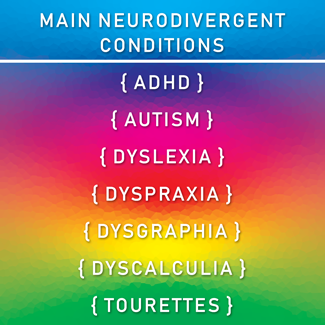
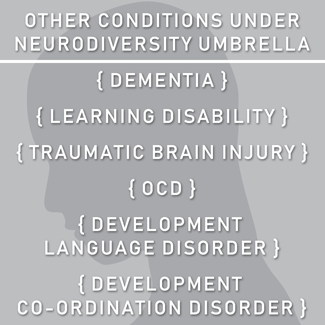 Neurodivergence refers to the specific variations within neurodivergent individuals. Understanding these differences helps to create more inclusive and supportive
environments for neurodivergent individuals in schools, workplaces, and in society. Find out more about the seven main conditions under the Neurodiversity umbrella below:-
{ ADHD }
ADHD, which stands for Attention Deficit Hyperactivity Disorder, is a condition that affects how a person’s brain works. It can make it harder for someone to concentrate, stay organised, remember things, control impulses and manage their energy levels. Some people with ADHD may find it difficult to sit still or may feel the need to move around a lot, while others may struggle mainly with paying attention and staying focused. Some people experience both types of difficulties. ADHD affects everyone differently and is not caused by laziness, bad behaviour or a lack of intelligence. People with ADHD may find everyday tasks, schoolwork, work or relationships more challenging, but they can also have strengths such as being creative, enthusiastic, energetic and good at solving problems. With the right support and understanding, people with ADHD can manage their difficulties and do well in life.
{ AUTISM }
Autism, also called Autism Spectrum Disorder (ASD), is a condition that affects how a person experiences and understands the world around them. It can affect the way a person communicates, interacts with other people and responds to sounds, sights, smells and other sensory experiences. Some autistic people may find social situations or changes in routine difficult, while others may have strong interests in particular subjects or activities. Autism affects everyone differently, which is why it is called a “spectrum”. Some autistic people may need a lot of support in their everyday lives, while others may be more independent. Autism is not an illness and does not need to be cured; it is a difference in the way the brain works. Autistic people can have many strengths, such as being creative, honest, focused, knowledgeable and good at noticing details. With understanding, acceptance and the right support, autistic people can learn, develop and achieve their goals.
{ DYSLEXIA }
Dyslexia is a learning difference that mainly affects reading, spelling and writing. People with dyslexia may find it difficult to recognise and understand written words, remember the order of letters or sounds, or read quickly. They may also have difficulty with spelling and organising written work. Dyslexia affects people in different ways and does not mean that someone is less intelligent. Many people with dyslexia have strengths such as creativity, problem-solving skills, good imagination and the ability to think about things in different ways. With the right support and teaching methods, people with dyslexia can develop their skills and succeed at school, work and in everyday life.
{ DYSPRAXIA }
Dyspraxia, also known as Developmental Coordination Disorder (DCD), is a condition that can affect movement, coordination and organisation. People with dyspraxia may find tasks such as handwriting, tying shoelaces, using tools or taking part in sports more difficult. They may also have difficulties with balance, planning movements, remembering instructions or organising their time. Dyspraxia affects everyone differently and is not caused by a lack of effort or intelligence. People with dyspraxia may also have strengths such as creativity, determination and good problem-solving skills. With understanding and the right support, they can manage their difficulties and achieve their goals.
{ DYSGRAPHIA }
Dysgraphia is a learning difference that affects writing skills. People with dysgraphia may find it difficult to write clearly, form letters, spell words, organise their ideas on paper or write quickly. Writing can sometimes feel tiring or frustrating because it may take a lot of effort to put thoughts into written words. Dysgraphia does not mean that a person has difficulty thinking or understanding ideas. In fact, they may have many good ideas but find it difficult to express them through handwriting or written work. Support such as using a computer, typing, speech-to-text tools or extra time can help people with dysgraphia communicate their ideas more easily.
{ DYSCALCULIA }
Dyscalculia is a learning difference that affects a person’s ability to understand and work with numbers and mathematical ideas. People with dyscalculia may find it difficult to learn number facts, understand mathematical symbols, remember times tables, tell the time, work with money or follow mathematical steps. They may also find it difficult to estimate amounts or understand how numbers relate to each other. Dyscalculia is not caused by laziness or a lack of intelligence, and people with dyscalculia can be very capable in many other areas. With suitable teaching methods, practical examples and the right support, they can improve their understanding of maths and manage everyday tasks involving numbers.
{ TOURETTES }
Tourette Syndrome is a neurological condition that causes a person to have tics. Tics are sudden movements or sounds that a person may make without meaning to, such as blinking, making movements, coughing, clearing their throat or making noises. Tics can change over time and may become more noticeable when a person is stressed, tired or excited. Not everyone with Tourette Syndrome swears or says inappropriate words; this is a common misunderstanding, and only a small number of people experience this type of tic. Tourette Syndrome affects people differently, and many people with the condition live normal, successful lives. Understanding and support can help people manage their tics and feel more comfortable in everyday situations.
MENTAL HEALTH CONDITIONS
Neurodivergent individuals are more prone to suffering from common mental health problems, but they present in different ways then they would in Neurotypicals, so it is harder to diagnose. These include, but are not limited to:-
{ STRESS }
Stress is a natural response that happens when a person feels under pressure, worried or unable to cope with a situation. It can be caused by things such as school, work, relationships, money, changes in life or difficult experiences. When someone is stressed, they may feel worried, overwhelmed, irritable or unable to relax. Stress can also cause physical symptoms such as headaches, tiredness, muscle tension or difficulty sleeping. A small amount of stress can sometimes help a person stay focused and complete tasks, but too much stress or stress that lasts for a long time can affect a person’s mental and physical health. Talking to someone, taking breaks, getting enough sleep and finding healthy ways to relax can help people manage stress.
{ ANXIETY }
Anxiety is a feeling of worry, fear or nervousness. It is normal to feel anxious sometimes, especially before something stressful or unfamiliar, such as an exam, interview or important event. However, some people experience anxiety very often or very strongly, even when there is no immediate danger. This can make everyday activities and situations feel difficult or overwhelming. Anxiety can cause thoughts such as worrying that something bad might happen, as well as physical symptoms such as a fast heartbeat, sweating, shaking, feeling sick or finding it difficult to breathe normally. Anxiety affects people differently, but with understanding, support and appropriate help, people can learn ways to manage their anxiety.
{ PHOBIAS }
Phobias are a type of anxiety disorder characterized by an intense, persistent, and often irrational fear of a specific object, situation, or activity. Unlike general fear, which is a normal response to real danger, phobias involve a level of fear that is disproportionate to the actual threat posed. Common examples include fear of heights, spiders, flying, or enclosed spaces. When confronted with the source of their phobia, individuals may experience immediate anxiety symptoms such as a rapid heartbeat, sweating, trembling, or a strong urge to escape. In many cases, people go to great lengths to avoid the feared stimulus, which can interfere with daily life.
Phobias are typically grouped into three main categories: specific phobias (such as animals or environments), social phobia (also known as social anxiety, involving fear of social situations), and agoraphobia (fear of situations where escape might be difficult). The exact causes of phobias are not always clear, but they may develop through learned experiences, traumatic events, or evolutionary factors. Treatment is often effective and may include therapies such as cognitive behavioural therapy (CBT), exposure therapy, and sometimes medication. With appropriate support, individuals can learn to manage their fears and reduce the impact of phobias on their lives.
{ DEPRESSION }
Depression is a mental health condition that can affect a person’s mood, thoughts, feelings and everyday life. Someone experiencing depression may feel very sad, empty, hopeless or unusually tired for a long period of time. They may lose interest in activities they normally enjoy and may find it difficult to concentrate, sleep or feel motivated. Depression can affect anyone and can be caused by different factors, including difficult life experiences, stress, biological factors or a combination of things. It is more than simply feeling sad or having a bad day, and it is not a sign of weakness. With the right support and treatment, many people with depression can feel better and manage their mental health.
{ POSTNATAL DEPRESSION }
Postnatal depression is a type of depression that can develop after having a baby. It can affect a parent’s mood, thoughts, feelings and ability to cope with everyday life. A person with postnatal depression may feel very sad, hopeless, anxious, overwhelmed or unusually tired. They may lose interest in things they normally enjoy, find it difficult to sleep even when the baby is sleeping, or feel like they are not good enough as a parent. Some people may also find it difficult to bond with their baby or may feel guilty about how they are feeling. Postnatal depression can happen to anyone and is not a sign of being a bad parent. It can be caused by a combination of physical, emotional and social factors, and it is different from the short-term “baby blues”, which are common after giving birth and usually improve within a few days. With the right support and treatment, people experiencing postnatal depression can recover and feel better.
{ BIPOLAR DISORDER }
Bipolar disorder is a mental health condition that can cause a person to experience significant changes in their mood, energy levels and behaviour. A person with bipolar disorder may experience periods of mania or hypomania, when they feel unusually energetic, excited or confident and may need less sleep or make decisions without thinking about the consequences. They may also experience periods of depression, when they feel very sad, hopeless, tired or lose interest in things they usually enjoy. These changes can affect a person’s everyday life, relationships and ability to work or study. Bipolar disorder affects everyone differently and is not simply the same as normal mood changes. With the right treatment, support and understanding, many people with bipolar disorder can manage their symptoms and live fulfilling lives.
{ SCHIZOPHRENIA }
Schizophrenia is a serious mental health condition that can affect the way a person thinks, feels and understands the world around them. Some people with schizophrenia may experience hallucinations, such as hearing or seeing things that other people do not, or delusions, which are strongly held beliefs that are not based on reality. They may also find it difficult to organise their thoughts, concentrate, communicate or manage everyday activities. Schizophrenia affects people differently and is not the same as having multiple personalities, which is a common misunderstanding. It is not caused by a person’s character or a lack of effort. With appropriate treatment, support and understanding, many people with schizophrenia can manage their symptoms and live meaningful lives.
{ DEMENTIA }
Dementia is a general term used to describe a group of conditions that affect the brain and cause problems with memory, thinking and everyday activities. A person with dementia may become more forgetful, find it difficult to communicate, struggle to recognise familiar people or places, or have problems with planning and making decisions. Dementia is more common in older people, although it is not a normal part of getting older. There are different types of dementia, including Alzheimer’s disease, and the symptoms can vary from person to person. Dementia is usually progressive, which means that symptoms may become worse over time. Although there is currently no cure for most types of dementia, support, treatment and care can help people manage symptoms and maintain their quality of life.
{ EATING DISORDERS }
Eating disorders are mental health conditions that affect a person’s relationship with food, eating and their body image. Someone with an eating disorder may have difficult thoughts and feelings about their weight, body shape or food, which can lead to harmful eating habits or behaviours. There are different types of eating disorders, including anorexia nervosa, bulimia nervosa and binge-eating disorder. People may eat very little, overeat, make themselves sick, exercise excessively or have other behaviours that can harm their physical and mental health. Eating disorders can affect anyone, regardless of their age, gender, body size or background. They are serious illnesses and are not simply a choice or a way of trying to lose weight. With the right support and treatment, people with eating disorders can recover.
{ OCD }
OCD, or Obsessive-Compulsive Disorder, is a mental health condition that can cause unwanted, upsetting or repeated thoughts, known as obsessions, and urges to carry out repeated actions or behaviours, known as compulsions. For example, a person may have worries about germs, safety or something bad happening and feel that they must carry out a certain action to reduce their anxiety. Compulsions can include behaviours such as excessive washing, checking or counting, although OCD can affect people in many different ways. Having preferences for things to be neat or tidy does not automatically mean someone has OCD. OCD can take up a lot of time and interfere with everyday life, but with appropriate treatment and support, many people can manage their symptoms and feel better.
{ PTSD }
PTSD, or Post-Traumatic Stress Disorder, is a mental health condition that can develop after a person experiences or witnesses a very frightening, dangerous or traumatic event. Someone with PTSD may experience unwanted memories or flashbacks, nightmares, anxiety or upsetting thoughts about what happened. They may avoid people, places or situations that remind them of the event and may feel constantly alert, easily startled or unable to relax. Some people may also feel numb or disconnected from their emotions. PTSD affects people differently and can develop soon after a traumatic event or sometimes much later. It is not a sign of weakness, and with the right treatment, support and understanding, many people with PTSD can recover and manage their symptoms.